BRAIDSTOP PROFESSIONAL GUIDE 04
September 13, 2026 2026-09-13 14:56BRAIDSTOP PROFESSIONAL GUIDE 04

BRAIDSTOP PROFESSIONAL GUIDE 04
THE BRAIDER’S SCALP & HEALTH GUIDE
Before you braid the hair, look at what is underneath it.
PAGE 1 — THE SCALP IS PART OF THE SERVICE
A beautiful braid does not automatically mean a healthy service.
The scalp continues to:
- produce sebum
- produce sweat
- shed skin cells
- respond to products
- experience environmental exposure.
Protective styling changes manipulation.
It does not suspend scalp biology.
ASK
“Does this scalp look and feel suitable for this service today?”
PAGE 2 — TENSION IS NOT A BADGE OF HONOUR
One of the most dangerous beliefs in braiding is:
“If it hurts, it will last.”
The American Academy of Dermatology states that repeated pulling from tight hairstyles, including tightly braided hair, cornrows and extensions, can contribute to traction alopecia. It specifically advises paying attention to pain and irritation.
This means:
Pain is not proof of quality.
Pain is not proof of longevity.
Pain is information.
PAGE 3 — THE CASE STUDY
Client:
“I’ve always had my braids this tight.”
You notice:
- tension around the hairline
- tenderness
- visible pulling.
She says:
“Make them tighter.”
Your responsibility is not to argue.
Explain:
“I understand that you want longevity. I can create a secure style, but I don’t want to create unnecessary tension around your hairline or scalp. Let’s adjust the technique so we can aim for a secure result without deliberately increasing the pulling force.”
Professionalism sometimes means saying no to the requested method while still saying yes to the client’s goal.
PAGE 4 — KNOW YOUR LIMITS
A braider can:
observe
document
modify
postpone
recommend appropriate professional assessment.
A braider should not pretend to diagnose medical conditions.
THE QUESTION
Can you tell the difference between:
“I don’t know what this is”
and
“I know enough to recognise that I should not continue”?
That distinction is professional maturity.
GO DEEPER
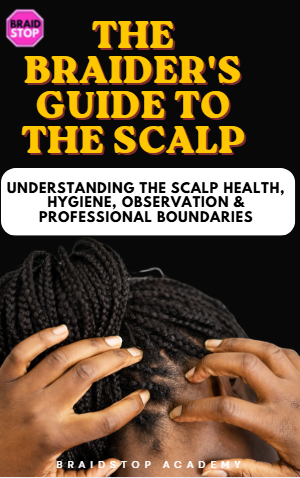
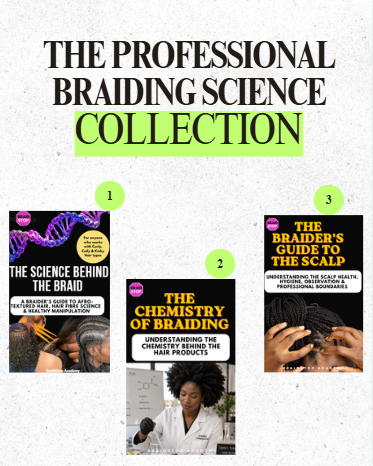
Explore The Braider’s Guide to the Scalp: