BRAIDSTOP PROFESSIONAL GUIDE 01
September 13, 2026 2026-09-13 14:43BRAIDSTOP PROFESSIONAL GUIDE 01

BRAIDSTOP PROFESSIONAL GUIDE 01
THE PROFESSIONAL BRAIDER’S GUIDE
What they don’t teach you when they teach you how to braid
PAGE 1 — YOU CAN BRAID. BUT ARE YOU A PROFESSIONAL?
Being able to create a beautiful braid is a technical skill.
Professional braiding is something bigger.
A professional braider needs to understand:
- the hair
- the scalp
- products
- tension
- extensions
- hygiene
- client communication
- safety
- time
- money
- boundaries
- aftercare.
The difference is judgement.
A beginner asks:
“Can I do this style?”
A professional asks:
“Should I do this style on this client, in this condition, using this method?”
That one question changes everything.
THINK ABOUT THIS
Two clients can request exactly the same hairstyle.
Client A has dense, healthy hair with good elasticity.
Client B has fine hair, low-density edges, previous breakage and a sensitive scalp.
Should they receive exactly the same service?
No.
The style may be the same.
The professional decision may not be.
PAGE 2 — THE PROFESSIONAL BRAIDER’S BRAIN
Before touching the hair, learn to think through five questions:
1. WHAT DO I SEE?
Look at:
- density
- strand characteristics
- length
- ends
- tangling
- breakage
- scalp condition
- hairline
- previous chemical or heat processing.
2. WHAT DOES THE CLIENT WANT?
Understand the desired:
- size
- length
- weight
- finish
- longevity
- maintenance level.
3. WHAT DOES THE HAIR NEED?
It might need:
- cleansing
- conditioning
- detangling
- less manipulation
- lighter extensions
- reduced tension
- a different style.
4. WHAT COULD GO WRONG?
Think before the problem occurs.
5. WHAT IS THE PROFESSIONAL RESPONSE?
Sometimes the answer is:
yes.
Sometimes:
yes, but modified.
Sometimes:
not today.
That is professional judgement.
PAGE 3 — THE CASE STUDY
A client wants waist-length knotless braids.
Her hair is:
- fine
- low density around the edges
- previously broken
- heavily coated in edge control
- difficult to detangle.
She says:
“I want them tiny and really long. I need them tight so they last.”
What do you do?
The beginner thinks:
“How can I make this hairstyle happen?”
The professional thinks:
Weight + size + tension + existing hair condition + installation time + maintenance = risk profile.
The professional may recommend:
- larger sections
- shorter extensions
- lighter extensions
- reduced tension
- a different style
- postponement if the hair/scalp condition requires it.
The goal is not to disappoint the client.
The goal is to create the best professional outcome.
PAGE 4 — YOUR FIRST PROFESSIONAL STANDARD
A professional braider doesn’t simply create a hairstyle.
They create a decision.
They decide:
- what is appropriate
- what is safe
- what is realistic
- what products are necessary
- what the client needs to know
- how the result should be maintained.
ASK YOURSELF
Would I still recommend this service if the client had never shown me a Pinterest or Instagram picture?
If the answer changes, you’re learning something important about client expectations versus professional assessment.
WANT TO GO DEEPER?
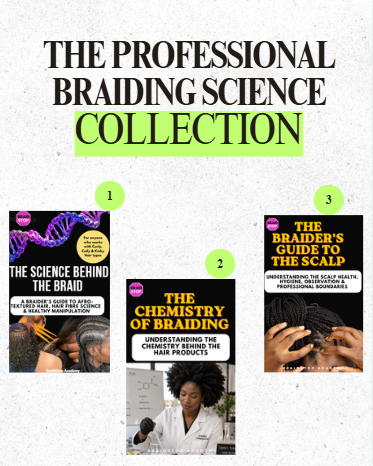
Explore The Science Behind the Braid, Product Chemistry for Braiders and The Braider’s Guide to the Scalp at:
BraidStop Academy — the home for all things braids.