Will a Robot Change the Way We Braid? The Bigger Question Is What Happens Next.
September 13, 2026 2026-09-13 16:05Will a Robot Change the Way We Braid? The Bigger Question Is What Happens Next.

Will a Robot Change the Way We Braid? The Bigger Question Is What Happens Next.
HALOBRAID AND THE FUTURE OF PROFESSIONAL BRAIDING
What a braiding robot tells us about where the industry is going
For an industry built almost entirely around the movement of human hands, the development of a braiding robot is about much more than technology.
It raises a bigger question:
What happens when one of the most physically repetitive parts of professional braiding can be assisted by a machine?
HaloBraid, developed by Yinka Ogunbiyi and David Afolabi, has been designed as a braiding-assist device rather than a replacement for the stylist. The concept is relatively simple: the stylist begins the braid, while the device assists with the repetitive continuation of the process. The company has positioned the technology around improving efficiency while reducing some of the physical demands of braiding.
And that is where the conversation becomes interesting.
Because this is not really a story about a robot.
It is a story about labour, expertise, productivity and the future of the profession.
BRAIDING HAS ALWAYS HAD A PHYSICAL LIMIT
A finished braid can look effortless.
The process is anything but.
Hours of repetitive finger, wrist, shoulder and neck movements are required to produce the final result. For the professional, time is therefore not simply money.
Time is physical capacity.
A stylist can increase prices. They can improve their speed. They can take on more clients. But when every additional euro depends on more hours of physical work, there is eventually a limit.
This is why technology such as HaloBraid is worth paying attention to.
It introduces another possibility:
Can productivity increase without requiring the stylist to work harder with their body?
That could be significant for an industry where physical sustainability is rarely discussed as seriously as revenue and bookings.
THE ROBOT DOESN’T REMOVE THE PROFESSIONAL
The easiest reaction is to ask whether robots will replace braiders.
But that question overlooks what a professional braider actually does.
Braiding is not simply repetitive hand movement.
A professional assesses the hair. They consider density, elasticity, previous chemical or heat processing, existing damage and the weight of extensions. They interpret what the client wants, determine what is realistic, manage tension and recognise when a requested service may not be appropriate.
They also communicate, consult, problem-solve and manage the client experience.
Those are professional decisions.
A machine assisting with repetitive movement does not eliminate them.
In fact, something quite interesting may happen:
As repetitive work becomes easier, professional judgement may become more valuable.
THE FUTURE BRAIDER MAY NEED MORE KNOWLEDGE, NOT LESS
For a long time, technical speed has been one of the clearest measures of progression in braiding.
The beginner takes longer.
The experienced stylist becomes faster.
The expert becomes highly efficient.
Technology potentially changes that progression.
Instead of asking only, “How can I make my hands faster?”, the professional can begin asking:
“Which parts of my workflow actually require my hands?”
That is a different way of thinking about the profession.
If technology can assist with execution, the value of the professional may increasingly move towards assessment, judgement, quality control, creativity, communication and decision-making.
And that has an important implication for education.
EDUCATION HAS TO MOVE WITH THE INDUSTRY
The future of braiding cannot be built around technique alone.
Knowing how to section, grip, feed and finish will always matter.
But the modern professional also needs to understand why the hair behaves the way it does, how the scalp responds, how products interact with the hair, how tension and extension weight affect a service, how to assess risk, how to price sustainably and how to create a professional client experience.
And increasingly, they need to understand technology.
Not because every braider will use a robot.
But because technology is becoming part of the professional environment.
This is why BraidStop Academy has always taken a broader view of braiding education.
The internet can show you the braid.
But professional education should teach you the thinking behind it.
PRODUCTIVITY DOESN’T HAVE TO MEAN MORE CLIENTS
There is another important conversation here.
If technology allows a service to be completed faster, the obvious assumption is that the stylist should simply book another client.
But why?
Perhaps the stylist wants to increase revenue.
Perhaps they want to reduce the number of appointments they perform.
Perhaps they want to finish work earlier.
Perhaps they want to spend more time on consultation, content, education or another part of their business.
All of those are valid.
Productivity should not automatically mean doing more.
Sometimes productivity means doing the same amount of work with less physical cost.
That could be one of the most valuable possibilities technology brings to professional braiding.
THE REAL ADVANTAGE WILL STILL BE HUMAN
Technology will not automatically make someone a better braider.
If a stylist does not understand tension, technology does not teach them tension.
If they cannot recognise when a client’s hair is unsuitable for a particular service, faster execution does not solve the problem.
If their pricing is wrong, increased capacity does not automatically create profit.
Technology can make a good system more efficient.
It can also make a poor system faster.
That is why knowledge matters.
The professional of the future may not simply be the person with the fastest hands.
They may be the person who knows how to combine:
human skill + science + judgement + technology + business.
THIS IS THE BIGGER STORY
HaloBraid may evolve considerably as the technology develops. Other companies may enter the space. We do not yet know exactly what the future of automated or assisted braiding will look like.
But we already know something has changed.
Technology developers are looking at braiding as an industry worth innovating for.
That matters.
It suggests that braiding is moving further away from being viewed simply as an informal skill and towards being recognised as a professional sector with its own technology, education, economics and innovation.
And that should encourage the industry to ask bigger questions.
How should braiders be educated?
How can the work become more physically sustainable?
How should technology be incorporated into professional training?
How should pricing evolve as productivity changes?
What should the modern braiding business look like?
And ultimately:
What does it mean to be a professional braider in the next decade?
THE FUTURE IS NOT JUST ABOUT BETTER BRAIDS
At BraidStop Academy, we see developments like HaloBraid as a signal that the industry is entering a more sophisticated era.
The future braider will still need exceptional hands.
But exceptional hands alone may not be enough.
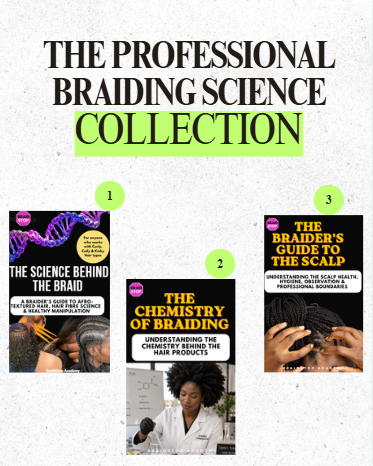
They will need to understand hair science, scalp health, product chemistry, safety, client experience, business, technology and professional judgement.
Because the goal of education should not simply be to prepare professionals for the industry that exists today.
It should prepare them to think about the industry that comes next.
The future of braiding will not belong to technology alone.
It will belong to professionals who know how to use technology without losing the expertise that makes their profession valuable.
That is the conversation BraidStop Academy wants to be part of.
Not just teaching people how to braid.
Helping shape the future of professional braiding.
Explore professional education, free guides and resources from BraidStop Academy.